Empty Leave-to-Appeal Reasons: The Procedural Move That Creates a New Point of Attack
The case in 20 seconds
A court refuses prövningstillstånd (leave to appeal). The reasons are almost empty: the statutory thresholds are recited, the court says it reviewed the material, and leave is refused.
The obvious response would be: “The reasons are too short.” That is not the strongest move here.
The stronger move is:
**Do not ask: Why did you refuse leave?
Ask: Was the expressly raised, mandatory leave ground actually part of the decision – or may it have been overlooked?**
That does not simply ask the court to decide the same leave question again. It changes the object of the request: from the correctness of the refusal to a possible procedural förbiseende – an oversight.
AL-CS-004 shows how that shift was constructed, why a formulaic leave refusal makes it possible, and where the legal limits lie.
1. The problem: a formulaic “no” ends the ordinary route of review
In this case, Arbetsdomstolen had two separately pleaded grounds for leave before it:
granskningsdispensunder49 kap. 14 § 2 RB;ändringsdispensunder49 kap. 14 § 1 RB.
Both were developed independently in the appeal.
The later refusal contains, in substance, only three elements:
- the statutory leave thresholds;
- a statement that the court reviewed the material;
- the conclusion that leave would not be granted.
The central sentence is:
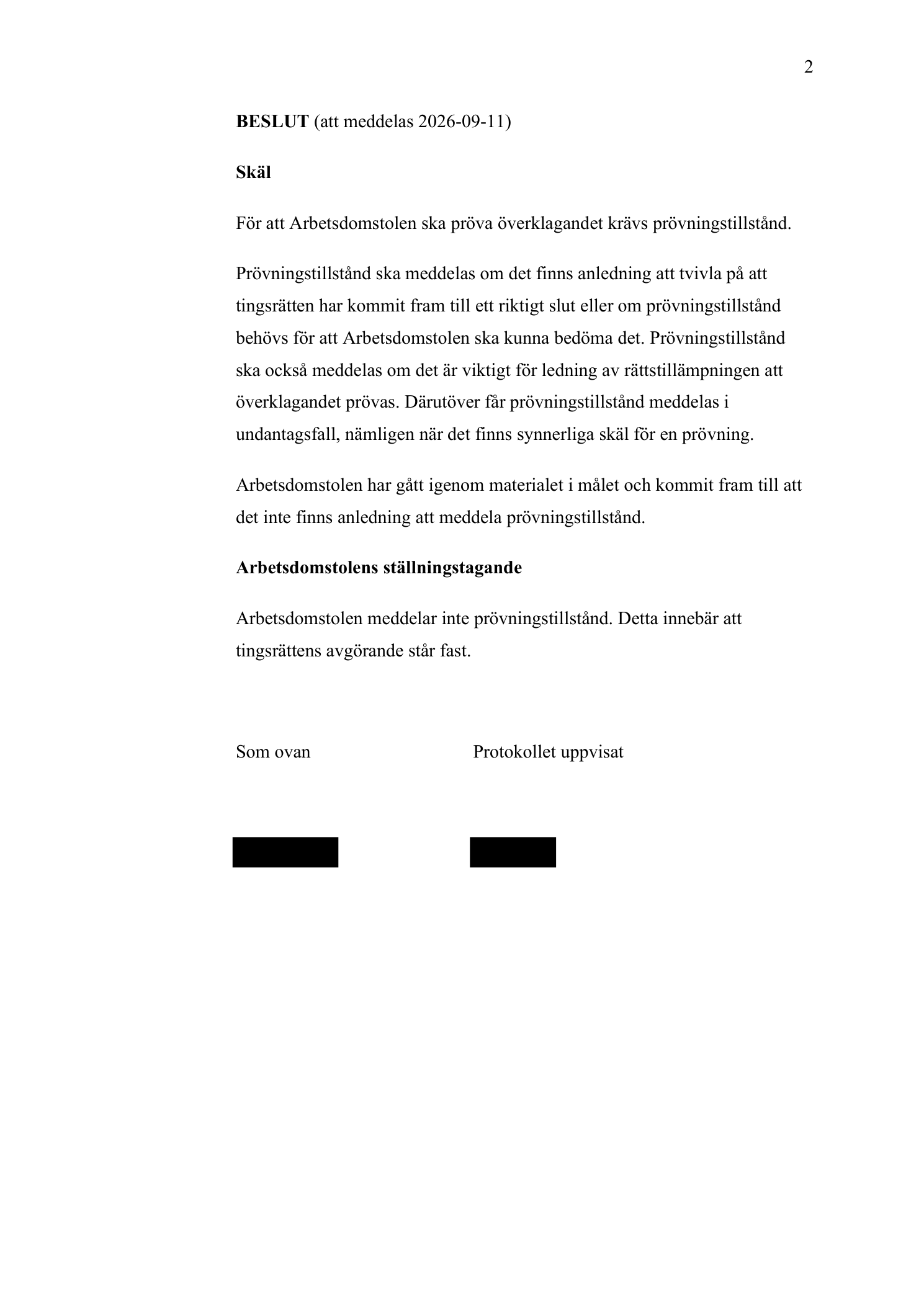
“Arbetsdomstolen har gått igenom materialet i målet och kommit fram till att det inte finns anledning att meddela prövningstillstånd.”
The text does not show how the two expressly pleaded leave grounds were dealt with.
That matters, but so does the evidential boundary: the brevity does not prove that no internal examination took place. The decision proves only what it visibly says and what it visibly leaves unstated.
2. The wrong attack: “Give fuller reasons”
An almost content-free leave refusal invites two reactions that are legally weaker.
2.1. Dead end 1: demand a fuller explanation
The first response is:
“The decision is too short. The court must answer every leave ground point by point.”
The law does not straightforwardly support such a blanket proposition. 17 kap. 12 § RB does not mean that every refusal of leave must contain detailed, ground-by-ground reasoning.
Attacking brevity alone therefore turns a transparency problem into no established procedural error.
2.2. Dead end 2: simply re-argue the refused leave application
The second response is:
“The refusal was wrong. Decide the leave question again.”
That also misses the procedural posture. In this route, Arbetsdomstolen is the final ordinary instance and its decisions are generally not appealable.
The practical value of the case therefore lies in not running the same merits argument a second time.
3. The move: change the question
The later “oversight request” works at a different level.
It expressly does not say:
- that the decision is defective merely because it is short;
- that the court must retrospectively write better reasons;
- that
17 kap. 15 § RBautomatically opens a fresh merits review.
Instead it first isolates a narrower question:
Were the expressly raised, mandatory leave questions actually included in the leave review that produced the decision?
That is the decisive shift.
The original question is:
Was the refusal of leave correct?
The new question is:
Was this specific mandatory review point part of the decision at all?
Small change in wording; substantial change in procedural object.
4. Why the move is unusually strong in this case
Not every short refusal supports the same strategy. This case is unusually clean because the appeal had already created the necessary record.
4.1. 1. The leave grounds were expressly named
Granskningsdispens and ändringsdispens were not merely implicit in the facts. Both were tied expressly to 49 kap. 14 § RB.
That makes it possible later to identify exactly which review questions were before the court.
4.2. 2. The two grounds performed different functions
The arguments were not duplicates.
For granskningsdispens, the logic was that the correctness of the district court decision could not reliably be assessed without leave because the decisive evaluation was not visible.
For ändringsdispens, the logic was that there were concrete reasons to doubt the correctness of the result, including new procedural material and a changed procedural situation.
Those are separate review axes.
4.3. 3. The refusal visibly answers neither one
The decision recites the statutory thresholds and says the material was reviewed. It does not visibly state:
- why
granskningsdispenswas absent; - why
ändringsdispenswas absent; - or whether both were independently addressed.
Again, that is not proof of actual oversight. It makes the oversight question objectively formulable.
5. The legal lever in three stages
5.1. Stage 1: 49 kap. 14 § RB makes the leave grounds review rules
The grounds in 49 kap. 14 § RB are not optional rhetorical labels. Where a statutory leave ground exists, leave is to be granted.
For AL-CS-004, this matters because the issues raised in the appeal were tied to statutory leave categories, not merely to argumentative preferences.
5.2. Stage 2: the leave review is not wholly confined to party submissions
In NJA 2025 s. 978, Rya kraftvärmeverk, Högsta domstolen stresses that the leave rules are mandatory and that the appellate court is not limited to the precise submissions made by the appellant. It must itself attempt to determine whether a ground for leave exists.
That sharpens the point: if a statutory leave ground is expressly placed before the court, asking whether it was included in the review is not an artificial afterthought.
5.3. Stage 3: 17 kap. 15 § RB is a possible consequence, not the starting premise
The oversight request does not claim that every omitted consideration can automatically be corrected or supplemented under 17 kap. 15 § RB.
Its sequence is more disciplined:
- determine first whether there was an objectively identifiable
förbiseende; - only if so, ask whether
rättelse,komplettering, or another procedural basis is available; - if not, request a formal position on the filing.
That is much stronger than asserting: “You overlooked something, therefore you must correct the leave decision.”
6. How to build the oversight request
The practical construction can be reduced to five steps.
6.1. Step 1: do not re-run the old dispute
The request does not open by repeating the entire evidential argument. It makes clear that it is not asking for a second merits review.
6.2. Step 2: identify the mandatory review point precisely
State exactly which statutory leave ground was expressly raised and where it appeared in the appeal.
Here, the key grounds were:
49 kap. 14 § 2 RB–granskningsdispens;49 kap. 14 § 1 RB–ändringsdispens.
6.3. Step 3: place the visible decision next to the appeal
Do not speculate about judicial intention. Compare documents:
Input: two separately developed leave questions. Output: generic thresholds, “material reviewed”, no leave.
The gap is the starting point, not proof of error.
6.4. Step 4: frame the issue as a possible förbiseende
Ask whether the specific mandatory review question may not have been captured in the decision.
Claim no more than the documents support.
6.5. Step 5: keep the requested consequence conditional
Only then ask, conditionally, whether the matter can be dealt with by:
rättelse, if the statutory conditions are met;komplettering, if those conditions are met;- another applicable procedural basis;
- or, in the alternative, a formal decision on the request.
That conditional structure is what makes the construction legally disciplined.
7. What the move can achieve – and what it cannot
7.1. It can create a new decision point
The filing attempts to force a position on a question the original leave refusal does not visibly answer:
Was the expressly raised mandatory leave ground included in the review or not?
If oversight is denied, the court has at least addressed that specific allegation. If oversight is accepted, only then does the correction question arise.
7.2. It does not turn silence into proof
The strongest form of the argument is not:
“Because the decision says nothing, the court did not consider the ground.”
That would overstate the evidence.
The defensible proposition is:
Because the decision gives no case-specific indication of how the ground was treated, the text leaves open whether and how it was addressed. That openness allows a precise oversight question to be raised.
7.3. It guarantees neither leave nor correction
This is not an automatic appeal mechanism and not a hidden right to a new merits review.
Whether 17 kap. 15 § RB actually permits correction or supplementation in a specific case is a separate legal question. This study documents the construction of the lever, not a proven entitlement to a successful correction.
8. When the approach can transfer to other leave refusals
The approach becomes most useful when four elements coincide:
- a specific statutory leave ground was expressly identified;
- it was developed so its independent review function is clear;
- the refusal is wholly generic;
- no case-specific treatment of that identified review point is visible.
The cleaner points 1 and 2 are, the less the later filing needs to assume.
That produces a practical lesson before leave is refused: if a party wants to preserve a later oversight argument, the leave grounds should already be separated, statute-linked, and auditable in the appeal itself.
9. Not only Arbetsdomstolen: why the decision type matters
In the Arvid Lane material reviewed outside this single-case corpus, every leave refusal so far seen from Kammarrätt, HFD and AD followed the same visible basic pattern:
statutory leave thresholds → generic statement that the material was reviewed → refusal of leave.
This is not a statistical claim about all Swedish leave decisions. It describes only the material actually reviewed by Arvid Lane so far.
That is why AL-CS-004 has practical value beyond one labour-law file: it supplies a concrete test for this repeatedly observed formulaic decision type.
10. The institutional mechanism: abstraction protects the decision
10.1. The Abstraction Shield
The decision moves the presentation from the concrete dispute to the statutory level of abstraction.
Specific questions about granskningsdispens and ändringsdispens went in. The visible answer is generic: criteria recited, material reviewed, no leave.
That is a characteristic function of the Abstraction Shield: the decision is formally sufficient to communicate an outcome while the concrete chain of reasoning remains unavailable to external inspection.
10.2. Documentation Gradient
The case also shows a Documentation Gradient:
- high detail in the appeal;
- minimal detail in the leave refusal;
- high detail again in the oversight request.
The conflict is therefore not only about the outcome. It is also about the radically different visibility of what was supposedly reviewed.
11. Practical check: is the move defensible in my case?
| Question | Why it matters |
|---|---|
| Which statutory leave ground was expressly raised? | Without an identifiable review point, the filing easily collapses into a complaint about brevity. |
| Where exactly is it in the appeal? | The later request must trace back to primary text. |
| What makes it an independent ground rather than a repeated merits argument? | Only a distinct review point can be isolated as possibly overlooked. |
| What does the refusal visibly say about it? | The analysis must stay with visible statements and omissions. |
| Which consequence is requested only conditionally? | Correction or supplementation must not be presented as automatic. |
If those five questions cannot be answered cleanly, the “move” risks becoming little more than a repetition of the failed appeal.
12. The AL-CS-004 formula
The practical value of the case can be reduced to two sentences:
Not: “Why did you reject my appeal?”
But: “Was this expressly raised, mandatory leave ground actually part of your decision?”
Then:
If yes: the court has positioned itself on the oversight allegation.
If no: only then does the question arise whether, and on what procedural basis, the omission can be corrected.
That is the move. The empty leave reasoning is not itself the attack. Its lack of case-specific visibility becomes the starting point for a narrower, new procedural question.
13. Sources
13.1. Case sources
- [D1] Appeal to Arbetsdomstolen, Day 1.
- [D2] Anonymised Arbetsdomstolen decision on
prövningstillstånd, Day 4. - [D3]
Begäran om rättelse eller komplettering med anledning av möjligt förbiseende, Day 4.
13.2. Legal sources
- Rättegångsbalk (1942:740), in particular Chapter 17 §§ 12 and 15 and Chapter 49 § 14
- Lag (1974:371) om rättegången i arbetstvister, in particular Chapter 2 § 4, Chapter 4 § 12 and Chapter 5 § 3
- NJA 2025 s. 978, Rya kraftvärmeverk
- NJA 2014 s. 29
- NJA 2019 s. 569, Myrans inteckning
14. Appendix A: original images of the anonymised decision
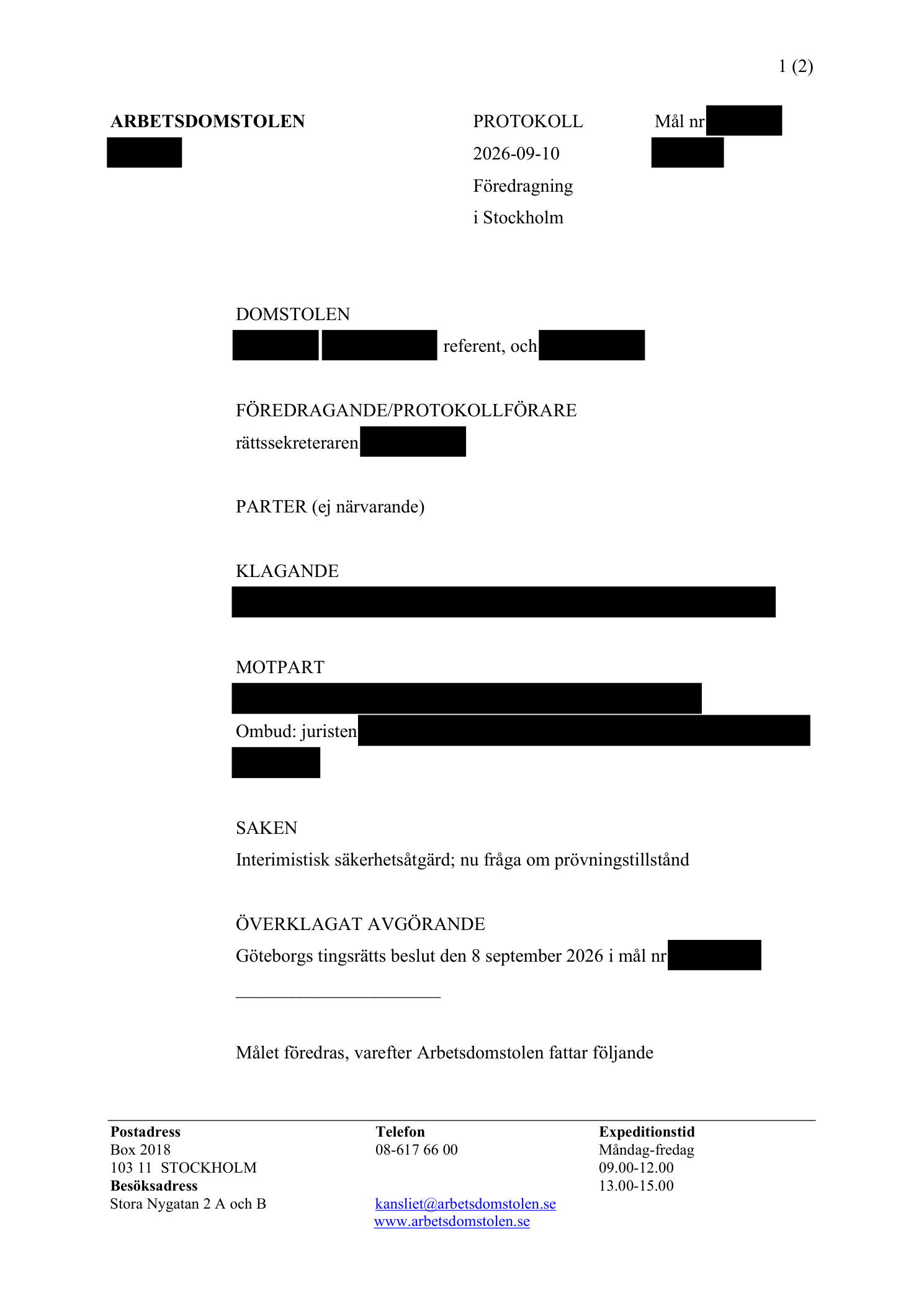
The following images are facsimiles of the already anonymised original decision. Calendar dates visible in the source image are part of the primary document; the case-study narrative itself uses relative time for procedural events.
15. Appendix B: the “oversight request” as an example
15.1. Publication-adapted example
The following example is based on the request actually filed in the examined case. Personal names and personal contact details have been removed, and the chronology has been adapted to the case study's relative-time standard. The legal structure and the core Swedish argument are preserved.
ARBETSDOMSTOLEN
BEGÄRAN OM RÄTTELSE ELLER KOMPLETTERING MED ANLEDNING AV MÖJLIGT FÖRBISEENDE
Jag begär att Arbetsdomstolen omedelbart prövar om de uttryckligen åberopade dispensgrunderna enligt 49 kap. 14 § 1 och 2 rättegångsbalken har förbisetts vid beslutets tillkomst.
Om Arbetsdomstolen finner att beslutet innehåller en uppenbar oriktighet till följd av ett sådant förbiseende som omfattas av 17 kap. 15 § första stycket RB, begär jag att beslutet rättas.
Om domstolen i stället finner att någon fråga som skulle ha avgjorts i samband med det slutliga beslutet av förbiseende inte har blivit avgjord och att förutsättningarna enligt 17 kap. 15 § andra stycket RB är uppfyllda, begär jag att avgörandet kompletteras.
I den utsträckning annan tillämplig processuell grund medger att ett konstaterat förbiseende korrigeras innan extraordinärt rättsmedel behöver tillgripas, begär jag att Arbetsdomstolen använder detta processuella utrymme.
Om Arbetsdomstolen anser att något sådant utrymme inte föreligger, begär jag i andra hand ett formellt beslut beträffande denna begäran.
15.1.1. 1. Rättslig utgångspunkt
Av 5 kap. 3 § lagen (1974:371) om rättegången i arbetstvister följer att rättegångsbalkens regler gäller i tillämpliga delar och att Arbetsdomstolen som fullföljdsinstans tillämpar de regler som gäller för hovrätt.
Av 4 kap. 12 § samma lag följer att tingsrättens domar och beslut överklagas till Arbetsdomstolen enligt 49 kap. rättegångsbalken.
Enligt 49 kap. 14 § RB ska prövningstillstånd meddelas om någon av de där angivna dispensgrunderna föreligger.
Högsta domstolen har i NJA 2025 s. 978, ”Rya kraftvärmeverk”, klargjort att reglerna om prövningstillstånd är obligatoriska och att tillståndsprövningen inte är begränsad till vad klaganden har anfört. Överrätten måste självmant försöka utröna om det finns skäl att meddela prövningstillstånd. Högsta domstolen framhåller också att ändringsdispens ska tillämpas generöst och att brister i underrättens skäl i många fall kan aktualisera granskningsdispens.
Den aktuella frågan är därför inte om Arbetsdomstolen ska göra en ny fri materiell bedömning, utan om ett förbiseende kan ha förekommit beträffande dispensgrunder som domstolen enligt lag hade att pröva.
15.1.2. 2. Den relevanta beslutskedjan
Före dag 1
Tingsrätten hade tidigare avslagit begäran om säkerhetsåtgärd med hänvisning till att sannolika skäl inte hade visats. Den materiella prövning som bar den slutsatsen gick enligt klaganden inte att identifiera i besluten.
Senare tillkom nytt processmaterial. Motparten utvecklade bland annat sin materiella grund och tingsrätten krävde ett särskilt och preciserat bemötande av delar av detta material.
Dag 1 – överklagandet till Arbetsdomstolen
Just den bristande kontrollerbarheten gjordes uttryckligen till en självständig grund för prövningstillstånd.
Under en särskild rubrik åberopades granskningsdispens enligt 49 kap. 14 § 2 RB. Det angavs uttryckligen att det inte gick att utläsa vilken del av den åberopade sannolikhetskedjan som inte godtogs, vilken betydelse det nya processmaterialet hade tillmätts eller varför omständigheterna sammantaget inte nådde upp till rekvisitet sannolika skäl.
Därutöver åberopades i ett självständigt avsnitt ändringsdispens enligt 49 kap. 14 § 1 RB med hänvisning till det nya processmaterialet och den förändrade processuella situationen.
Dag 4 – Arbetsdomstolens beslut
Arbetsdomstolen anger:
”Arbetsdomstolen har gått igenom materialet i målet och kommit fram till att det inte finns anledning att meddela prövningstillstånd.”
Beslutet redovisar inte separat hur de uttryckligen åberopade grunderna enligt 49 kap. 14 § 1 och 2 RB behandlades.
15.1.3. 3. Det möjliga förbiseendet
Begäran grundas inte på att Arbetsdomstolens beslut är kortfattat som sådant och inte heller på ett krav på att domstolen i efterhand ska utveckla sina domskäl.
Den gäller ett möjligt processuellt förbiseende.
Granskningsdispens åberopades uttryckligen och utvecklades separat. Ändringsdispens åberopades också uttryckligen och utvecklades separat. Trots detta meddelades inte prövningstillstånd, och av det synliga beslutet går det inte att utläsa hur dessa särskilda dispensfrågor behandlades.
Detta visar inte i sig att de faktiskt förbisågs. Men det ger anledning att ställa den avgränsade frågan om de uttryckligen aktualiserade dispensgrunderna omfattades av den tillståndsprövning som ledde fram till beslutet.
15.1.4. 4. 17 kap. 15 § RB och gränsen för begäran
Rättelseinstitutet enligt 17 kap. 15 § första stycket RB har en begränsad räckvidd och utgör inte en generell möjlighet att ompröva ett materiellt ställningstagande. Ett förbiseende av ett lagrum, ett rättsfall eller processmaterial innebär inte automatiskt att beslutet kan rättas.
Begäran innebär därför inte att Arbetsdomstolen med stöd av 17 kap. 15 § första stycket ska göra en ny materiell värdering av samma processmaterial.
Den fråga som först begärs prövad är snävare: om en uttryckligen åberopad och obligatorisk dispensfråga över huvud taget omfattades av tillståndsprövningen.
Om Arbetsdomstolen konstaterar att en sådan fråga av förbiseende inte kom att omfattas av beslutet, begärs därefter att domstolen tar ställning till om felet kan hanteras genom rättelse enligt 17 kap. 15 § första stycket RB, komplettering enligt andra stycket eller annan tillämplig processuell grund.
15.1.5. 5. Begäran om rättelse eller komplettering
Om Arbetsdomstolen finner att en uttryckligen aktualiserad dispensfråga har fallit bort genom ett sådant objektivt konstaterbart förbiseende som omfattas av 17 kap. 15 § första stycket RB, begär jag att domstolen vidtar den rättelse som bestämmelsen medger.
Om situationen i stället omfattas av 17 kap. 15 § andra stycket RB, därför att domstolen av förbiseende har underlåtit att fatta ett beslut som skulle ha meddelats i samband med det slutliga beslutet, begär jag att avgörandet kompletteras i den utsträckning bestämmelsen medger.
Om ett konstaterat förbiseende kan korrigeras på annan tillämplig processuell grund, begär jag att denna möjlighet används.
15.1.6. 6. I andra hand – formellt beslut
Om Arbetsdomstolen finner att de åberopade dispensgrunderna inte har förbisetts, eller att ett eventuellt förbiseende inte kan rättas eller kompletteras med stöd av 17 kap. 15 § RB eller annan tillämplig processuell grund, begär jag att Arbetsdomstolen fattar ett formellt beslut med anledning av denna framställning.
Begäran är alltså inte att skrivelsen endast ska läggas till akten, utan att domstolen uttryckligen tar ställning till om det föreligger processuella förutsättningar för rättelse eller komplettering.
15.1.7. 7. Sammanfattning
Granskningsdispens och ändringsdispens åberopades uttryckligen och separat. Reglerna om prövningstillstånd är obligatoriska och överrätten ska dessutom självmant försöka utröna om någon dispensgrund föreligger.
Jag begär därför att domstolen prövar om de uttryckligen aktualiserade dispensgrunderna har förbisetts vid beslutets tillkomst och, om ett förbiseende konstateras, därefter tar ställning till om och hur detta kan korrigeras enligt 17 kap. 15 § RB eller annan tillämplig processuell grund.
Om sådan möjlighet saknas begär jag ett formellt beslut om detta.
Med vänlig hälsning [NAME]