

The Moment You Stop Believing
Connection to the Lane Analyses
“The Moment You Stop Believing” ties together several core Lane analyses. Its strongest connection is to the Mechanics of Responsibility Evaporation and the Invisible Responsibility Vacuum: a concrete question about who decided, on what basis, or what happens after an error is exposed can travel through roles, referrals and formal replies until responsibility itself disappears from view. It also maps directly onto Retroactive Justification Construction. The text describes the precise point where an initial mistake becomes institutionally stabilised: first something happens, then it is challenged, then it is repeated, and finally the outcome acquires a rationale. Where the explanation shifts over time, the Moving Grounds Pattern becomes relevant as well. The Complaint Wall appears when review mechanisms merely confirm that a formal response was sent instead of testing the substance of the objection.
The counterweight is the Documentation Gradient. Writing things down, comparing versions and preserving sequence makes contradictions, shifting explanations and later reconstruction harder to hide. Within LSAF, this part therefore connects most strongly to Responsibility Clarity, Documentation Degree, Communication Consistency, Follow-up Discipline, Formal Escalation Capability, Signal Interpretation and Power Asymmetry.
- Mechanics of Responsibility Evaporation
- The Invisible Responsibility Vacuum
- Retroactive Justification Construction
- The Moving Grounds Pattern
- The Complaint Wall
- Documentation Gradient
- Responsibility Clarity
- Documentation Degree
- Communication Consistency
- Follow-up Discipline
- Formal Escalation Capability
- Signal Interpretation
- Power Asymmetry
It almost never starts with a scandal. Usually, it starts with a simple question. Who decided this? On what basis? Why was this fact ignored? What happens now that the error is known? You ask politely. Then more precisely. Eventually, in writing. And at some point you understand: the problem is not that nobody knows the answer. The problem is that nobody wants to give it while silence remains easier. We grow up with the idea that authorities examine, courts weigh, companies take responsibility and rules apply equally to everyone. When an error becomes visible, it gets corrected. At least, that is the glossy version.
Reality is less poetic. Institutions do not run on rules first. They run on routines, templates, jurisdictions and the quiet hope that the person affected will eventually get tired. What worked yesterday gets repeated today. What creates work gets delayed. What creates responsibility gets forwarded. The mistake itself is rarely the decisive part. Mistakes happen. What matters is what happens next. Maybe it started as an accident. Then someone pointed it out. Then it happened again. Eventually it acquired a justification, a case number and a signature.
At that point, it is no longer just a mistake. It is a decision to keep it. That is where you stop believing. Not in law, democracy or public institutions. You stop believing the childish version in which those things work simply because somebody wrote them down neatly somewhere. A right protects nobody merely because it exists in a statute. A duty creates no responsibility if nobody has to explain whether it was fulfilled. A justification is not a review if it only restates the outcome in longer sentences. And a complaints body is not oversight if all it confirms is that the previous office formally sent a letter.
Modern arbitrariness rarely wears boots. It wears a blazer, runs on templates and wishes you a pleasant day. It does not forbid you to speak. It simply answers a different question. It does not openly refuse. It asks for more documents. It does not declare itself responsible. It sends you to somebody else who is not responsible either. By the end, every form is complete, every case number has been assigned and responsibility has successfully evaporated. It looks orderly. That is exactly why it works.
A procedure is not lawful merely because it looks like a procedure. Its purpose is not to manufacture paper. It is supposed to limit power, expose reasons and keep mistakes correctable. Otherwise, it is not a safeguard of the rule of law. It is bureaucracy with excellent letterhead. The rule of law does not reveal itself when nobody objects. It reveals itself at the point where an institution would have to admit that it got something wrong. Exercising power is easy. Correcting power is the real test.
Once you have seen that moment, you read decisions differently. You stop listening only to the polite words. You check whether the question was actually answered. You separate claims from evidence. You insist on writing because spoken words have an astonishing habit of disappearing the moment they become inconvenient. That does not make a person paranoid. It makes them awake. An individual may not have a legal department, an internal distribution list or professionals paid to rephrase their mistakes. But they can document. They can compare. They can place contradictions side by side. They can make sure today's explanation is not quietly replaced by a different one tomorrow.
A system has many employees. A citizen only needs a better memory. Trust does not mean asking no questions. Trust means an institution can survive questions. That it corrects errors instead of defending them. That its rules still apply when the result becomes inconvenient. Rights that only exist until somebody demands their application are not rights. They are decoration. That is why the Lane Manifest does not begin by claiming everything is broken. It begins with a far more uncomfortable demand: Show that it works.
Not in mission statements. Not in brochures. Not in carefully drafted replies designed to avoid every actual question. Show it where a person asks one clear question and the institution has nowhere left to hide behind its own language. Because the moment you stop believing is not the end of trust. It is the beginning of control.

The Friendly No
Connection to the Lane Analyses
“The Friendly No” describes the polished surface of an institutional mechanism that appears across several Lane analyses from different angles. Its closest match is The Abstraction Shield: the response remains formally present while concrete questions, objections and responsibility disappear behind phrases such as “carefully reviewed”, “we understand” and “we regret”. The connection to The Complaint Wall appears when polite repetition becomes the procedure itself. Material clarification fades, while the institution can point to the fact that it has already replied, already reviewed, already addressed the matter. The Invisible Control Level adds the behavioural layer: once a rejection is wrapped in perfect courtesy, the person who keeps pushing can be made to look unreasonable simply for refusing to treat tone as substance.
Within LSAF, this part connects most strongly to Communication Consistency, Signal Interpretation, Culture Filter, Responsibility Clarity, Documentation Degree and Power Asymmetry. The key tension is between the signal of review and the visible substance of review: the institution that controls the decision also holds a structural advantage in deciding when an answer counts as enough.
Sometimes a system does not tell you no. It tells you it understands your situation, appreciates your effort and has carefully reviewed your case. Then it leaves you exactly where you were before, only rejected more politely. Almost everyone knows these letters. They open with understanding, move through several paragraphs of professional concern and end with the same outcome that was apparently waiting there all along. “We understand that this situation is difficult for you.” Nothing gets easier. “We have carefully reviewed your objections.” None of them is mentioned. “We regret that we cannot give you a different answer.” As if the answer were weather. As if nobody chose it, nobody wrote it and nobody had the power to change it.
That is the Friendly No. It does not raise its voice. It does not threaten you. It does not call you difficult, unreliable or inconvenient. It uses your name, thanks you for your message and wishes you a pleasant day. Modern arbitrariness rarely wears boots. It wears a blazer, runs on templates and wishes you a lovely afternoon. That is exactly what makes it so hard to grab. Open harshness creates resistance. A clear no forces the person responsible to own the decision. Friendly ambiguity is more efficient. It performs respect without changing anything. It acknowledges your feelings without acknowledging your objection. It de-escalates the conflict in language while leaving every consequence entirely with you.
Empathy without consequence can become a form of administrative anaesthetic. You are supposed to feel heard even though nobody answered your question. You are supposed to believe a review took place even though the result was merely repeated. And when you ask again, you are told that the matter has already been addressed in detail. A remarkable loop emerges: first, your problem is acknowledged. Then your question is sidestepped. Then the outcome is repeated. Finally, the polite repetition itself becomes proof that your objection was reviewed.
The language has done its job. Not by clarifying what happened, but by making the exercise of power harder to see. The Friendly No separates the tone of a decision from its actual effect. The tone says: We take you seriously. The effect says: Nothing changes. The tone says: We understand. The effect says: You carry the consequences alone. And the more polished the language becomes, the more unreasonable the person who keeps asking can be made to look. Challenge a friendly rejection and you quickly seem ungrateful. Question a “careful review” and suddenly you are expected to explain why you refuse to trust the professional wording. The institution no longer has to show what it reviewed. You have to justify why the claim of a review is not enough.
That is a quiet but powerful shift. A question about responsibility becomes a question about your tone. An unresolved problem becomes a communication problem. And the person asking for a clear answer becomes the person who supposedly cannot accept that an answer has already been given. Courtesy is good. Respect matters. Nobody needs insulting letters or condescending case handling. But courtesy is not a substitute for substance. An institution owes a person more than a respectful tone. It owes them an answer to the question they actually asked. It should be possible to see which facts were considered, which objections were examined and why the institution still reached the decision it did.
Otherwise, the friendliness is packaging. A polite no is still a no. It just wears a tie and has been proofread by communications. Trust does not come from making every answer sound nice. Trust comes from words and actions matching. “We reviewed this” should mean the objections are visibly dealt with. “We understand” should be more than an opening phrase; it should be capable of affecting the decision. And “we regret” should not dissolve responsibility into sympathy. You do not judge an institution by how gracefully it writes a rejection. You judge it by whether it is willing to explain its decision, review it and correct it when necessary.
The tone of a letter shows how an institution wants to be seen. Its consequences show how it actually behaves. The friendliest no is still an exercise of power. It is just harder to hear.

Nobody Is Responsible
Connection to the Lane Analyses
“Nobody Is Responsible” sits directly on top of the Mechanics of Responsibility Evaporation and the Invisible Responsibility Vacuum. Both patterns describe the same structural trick: institutional impact remains real while personal and organisational responsibility becomes harder and harder to pin down. Roles stay visible. Tasks stay visible. Procedures stay visible. What disappears is the person or body that owns the final outcome. The Invisible Control Level adds another layer. Large systems coordinate action through procedures, roles and expectations. That makes it entirely possible for every participant to behave correctly within their narrow task while the overall result is still wrong, harmful or absurd. The system’s power does not disappear. It simply detaches itself from the individual face exercising it.
Within LSAF, this part connects most strongly to Responsibility Clarity, Power Asymmetry, Structure, Systemic Friction, Documentation Degree, Risk Concentration and Institutional Stability. The key question is whether harmful consequences can still be assigned internally to a responsible role or organisational unit, or whether division of labour has diluted responsibility until it effectively no longer exists.
There is a particular moment almost everyone knows once they have dealt with a large organisation for long enough: you know exactly what happened. The organisation knows too. The damage is visible. The decision can be traced. Only one thing suddenly becomes impossible to find: the person responsible for it. You write to the person who made the decision. They point to the policy. You ask about the policy. Another department owns that. The other department explains that it did not make the decision. The manager points to the procedure. Legal points to the operational team. Eventually, you are right back where you started, only now the email thread contains more names.
Everyone was involved. Nobody was responsible. It sounds absurd. Organisationally, it is remarkably efficient. Responsibility in large systems rarely disappears because somebody openly says, “I do not care.” It disappears by being broken into small pieces, each of them perfectly reasonable on its own. The caseworker only applied the rules. The manager relied on the caseworker. Legal only assessed the law. The complaints unit only checked whether procedure was followed. Senior management does not comment on individual cases. Every sentence can be completely plausible by itself.
Together, they create a system in which decisions can be made without anyone ever having to feel responsible for the decision. That is the crucial difference between jurisdiction and responsibility. Jurisdiction tells you who performs a particular step. Responsibility begins where somebody has to explain what all those steps produced in the end. Organisations love jurisdiction. Responsibility is much less convenient. Jurisdiction can be forwarded. Responsibility demands an answer. That is why “I am not responsible for that” is one of the most powerful sentences in modern bureaucracy. It sounds factual. It sounds neutral. Sometimes it is even entirely correct.
But it answers a different question. The real question is not always: Who handles this document? It is: Who makes sure the right thing happens in the end? And that is where the room suddenly goes quiet. This is not just a problem with public authorities. It works the same way in companies, insurers, banks, schools, hospitals and almost every large organisation. The bigger the system becomes, the easier it is for every participant to perform their tiny task correctly while the overall result becomes completely wrong.
That is one of the most dangerous properties of complex systems: They can fail without any single person ever feeling that they failed. Everybody did their part. The email was forwarded. The form was checked. The statement was requested. The deadline was entered. The case was closed. The person standing in front of the system still has the same problem. But internally, everything looks beautifully tidy. That is not an accident. Organisations prefer to measure what they can control: processing times, workflows, files, jurisdictions and closed cases.
Whether the original problem was actually solved fits much less neatly into a spreadsheet. A case can therefore be administratively successful and humanly catastrophic. That is where real responsibility begins. Not with asking whether everyone completed their tiny task. But with asking whether anybody is still looking at the whole. Who notices when five formally correct steps combine into an absurd result? Who is allowed to say: Stop. This cannot be right. Who has not only the authority, but the nerve, to reverse a decision after three departments have already explained why it was supposedly correct?
An institution without that person may have flawless processes. But it has nobody responsible. And responsibility cannot be replaced with an organisation chart. A state governed by law, a company or any other institution needs division of labour. Nobody can decide everything. Jurisdictions are necessary. But division of labour must not become division of responsibility until nothing is left but dust. Power does not disappear just because responsibility has been distributed. The decision still bites. The bill still remains unpaid. The damage still exists. The person still carries the consequences.
Only the institution has managed to make the author of its own impact disappear. That is why you should not allow yourself to be passed endlessly from one jurisdiction to the next. At some point, a different question has to be asked: Who takes responsibility for the outcome? Not who answers the email. Not who processes the form. Not who forwarded the case. For the outcome. Because if an organisation can make decisions with real consequences for real people, then somewhere there must also be a person or body that stands behind those consequences.
Otherwise, we have created something strange: Power with no owner. Decisions with no decision-maker. And responsibility that always lives one door further down the corridor. If everyone was responsible for a piece and nobody is responsible for the result, the system has not distributed responsibility. It has abolished it.
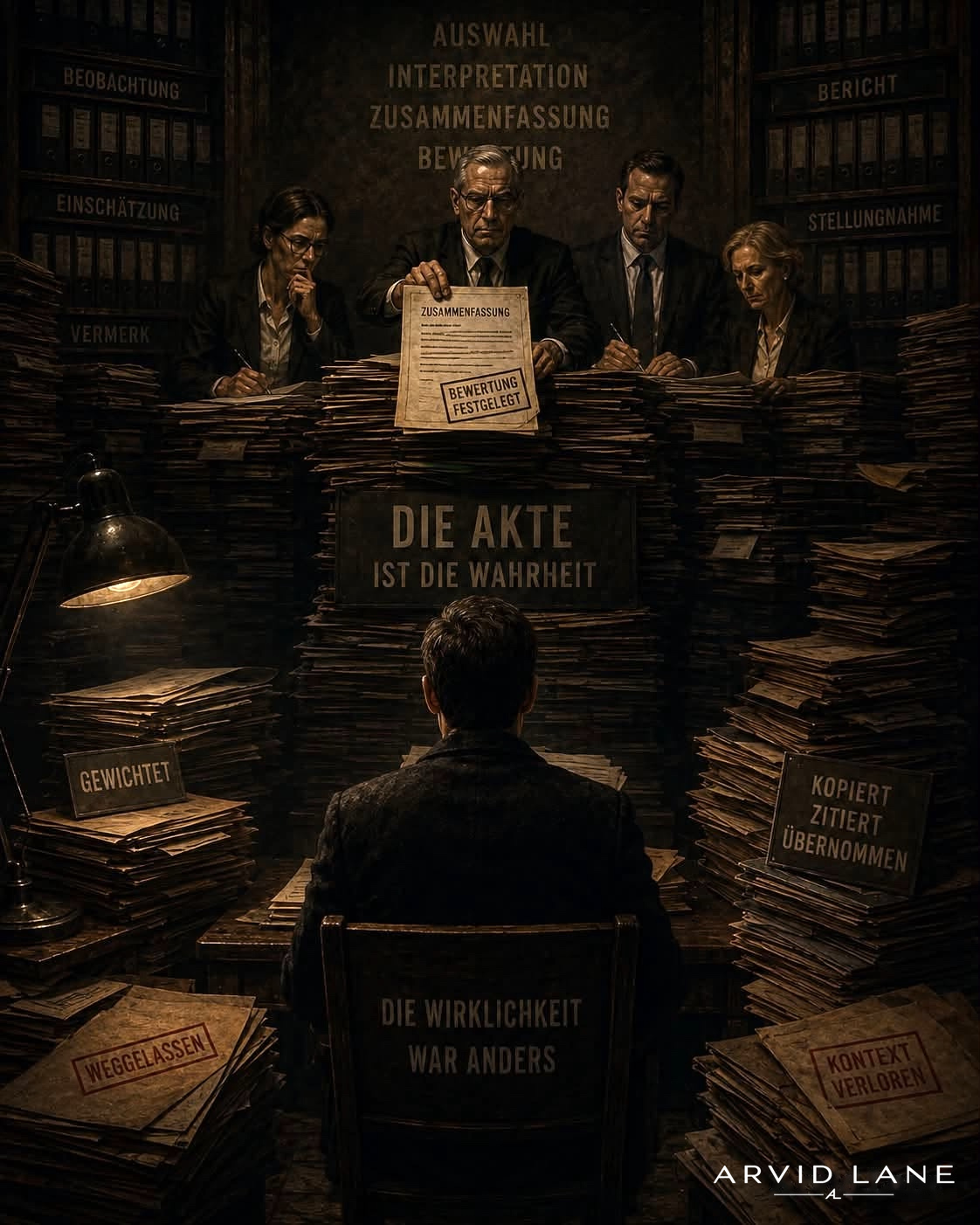
The File Is More Powerful Than Reality
Connection to the Lane Analyses
“The File Is More Powerful Than Reality” connects most directly to the Documentation Gradient, Systemic Blind Spots and the Paper Fog Matrix. The Documentation Gradient captures the fact that documentation does more than store information. It stabilises some perspectives while allowing others to lose weight. Once something is written into the record, it acquires structural durability and becomes the starting point for whatever comes next. Systemic Blind Spots add the selective-perception layer. Institutions do not record reality neutrally; they see through categories. Facts that do not fit the expected frame can disappear from the record or survive only as anomalies. The Paper Fog Matrix adds another distinction: volume is not evidence. A claim does not become better supported because it has been copied, quoted and summarised five times. Repetition can manufacture the appearance of certainty without adding a single independent source.
Within LSAF, this part connects most strongly to Documentation Degree, Communication Consistency, Signal Interpretation, Responsibility Clarity, Power Asymmetry, Structure and Risk Concentration. The central issue is who gets to define recorded reality, whether the chain of sources remains traceable, and whether institutional documentation can still be corrected before repetition starts outranking reality itself.
You are sitting in a meeting when you suddenly hear a version of your own story you barely recognise. You were there. You know what was said. You know what happened. But on the table in front of you is a document saying something else. And suddenly the paper has solved a problem reality never had: it has decided which version gets to stay. We like to think files simply document reality. Often they do. But a file is never reality itself. It is a selection from it. Someone decides what goes in, what stays out and how a conversation gets summarised. Uncertainty becomes “lack of insight”, a question becomes “resistance”, disagreement becomes “failure to cooperate” and fear becomes “concerning behaviour”.
None of those phrases has to be completely invented. That is precisely what makes this so dangerous. You can alter reality without openly lying. All you have to do is select, shorten, weight and interpret. A person says ten things. Nine do not fit the expected story. One does. Which one makes it into the file? From that moment on, something remarkable happens: the next person no longer meets you. They meet the description of you. The next caseworker reads the file, the manager reads the summary, the expert reads the background, the lawyer quotes the document. Eventually one decision cites another decision that relied on an assessment born from a summary.
An interpretation becomes a source. The source becomes a fact. And eventually you are the one expected to prove that something did not happen the way it has already been copied three times. That gives institutions an enormous advantage over the individual: they write first. Whoever documents first sets the starting point for everything examined afterwards. That does not mean files are inherently false. Complex systems could not function without documentation. Information has to move, decisions have to be traceable and cases have to be preserved. That is exactly why the file is so powerful. And power on that scale demands care.
A mistake in a conversation may last a minute. A mistake in a file can live for years. It gets copied, quoted, summarised and forwarded. Every repetition gives it more weight even though no new evidence has appeared. Five documents can contain the same mistake. That does not make five pieces of evidence. Sometimes it is just one mistake with an outstanding career. At that point documentation stops being mere administration. It starts producing reality. That is why the seemingly fussy question, “Where did this information come from?” is one of the most important questions you can ask a system.
Who originally said it? When? In what context? Is it an observation or an interpretation? Was the person concerned given a chance to respond? And do several statements really come from several independent sources, or are they simply copying one another? That is not pedantry. That is source criticism. We demand it from journalists. We demand it from scientists. We should demand it even more from institutions whose documents can decide money, work, liberty, families or a person’s future. A file must therefore never become more sacred than the reality it is supposed to describe. It has to remain correctable. Contradictions have to remain visible. Sources have to remain traceable. And a claim written down once must not become true merely because enough people copied it.
The most dangerous institutional error is not always the false statement. It is the false statement whose origin nobody checks anymore because it has been sitting in the file for long enough. People misremember. People interpret. People make mistakes. Paper does none of those things. Paper remembers exactly what a person once wrote on it. Even when it was wrong. So the moment an institution starts documenting your reality, read along. Ask questions. Correct early. Because eventually nobody will read what actually happened. They will only read what was written about it.

Complexity Is Power
Connection to the Lane Analyses
“Complexity Is Power” connects most directly to The Abstraction Shield, The System Pressure Curve and The Structural Impact Axis. The Abstraction Shield captures what happens when a concrete question gets pushed upward into procedure, categories, jurisdiction and general rules. The answer remains formally present, but becomes harder to test, harder to challenge and harder to use. The System Pressure Curve adds the asymmetry of time, effort and institutional friction. For the institution, one more procedural step may be routine. For the person affected, the same step may mean finding another department, understanding another deadline or producing another set of documents. The Structural Impact Axis shows that real leverage often sits at a handful of structural points where something can actually be decided, recorded or escalated, not where most of the communication happens.
Within LSAF, this part connects most strongly to Structure, Systemic Friction, Power Asymmetry, Responsibility Clarity, Signal Interpretation, Documentation Degree, Formal Escalation Capability, Follow-up Discipline, Time Pressure and Culture Filter. The core issue is the gap between formal access and practical access: a right can be open to everyone on paper and still become structurally unequal when only one side has the map.
You ask a simple question and get an answer that suddenly requires you to Google three new terms, contact two departments and dig up four documents. Before long, you know more about the procedure than about the thing you originally asked. And that is when you start to understand that complexity is not always just a problem. Sometimes, it is armour. Complex systems need rules. That is unavoidable. Large organisations cannot run on common sense alone. They need jurisdictions, deadlines, forms, technical language and procedures. The problem begins when that structure stops helping to clarify a matter and starts making it harder to reach.
Because complexity changes the balance of power. If you know the terminology, you move with confidence. If you know the procedure, you know when to ask. If you know which office actually decides, you can save weeks. If you know none of that, you can quickly look unprepared, emotional or “difficult” when all you are really doing is trying to work out what is happening. The system has the map. You have the front door. And often, you are not even speaking the same language.
That creates a strange situation: the person affected by a decision has to learn how the institution thinks before they can even challenge it properly. They have to read files, decode terminology, spot deadlines, separate jurisdictions and learn which wording opens a question and which wording closes it instantly. That is often called personal responsibility. Sometimes, it is just the admission fee. If you have enough time, education, energy or money, you can fight your way through. If you are exhausted, ill, alone, poor or simply busy having a life, you may lose not because you are wrong, but because the route to clarification requires more resources than you have.
That difference is discussed surprisingly rarely. A right can be written equally for everyone and still be radically unequal in practice. On paper, two people have the same opportunity to challenge a decision. In reality, one has a lawyer, time and peace. The other has three children, a night shift and a deadline they only understand when it is almost gone. Formally equal. Not even playing the same game. Complexity does not have to be deliberately designed. That matters. Many systems become complicated because new rules are stacked on old rules, exceptions are added, responsibilities are split and individual problems are patched one by one. Nobody has to arrive at work thinking: How do we make this as incomprehensible as possible today?
The result can still feel exactly like that. Because systems usually optimise from the inside. One more review adds internal security. Another jurisdiction distributes workload. A new form standardises handling. A new exception fixes a special case. From the inside, every step looks reasonable. From the outside, you get a maze. And a maze needs no guard if most people give up at the junctions. That is the real power of complexity. It never has to reject you openly. It only has to generate enough friction.
One more form. One more deadline. One more department. One more “clarification”. One more rule pointing to another rule. Eventually, a factual question turns into a second job. And then something very convenient happens for the institution: the person who gives up has not been proven wrong. They simply disappear. The file can be closed. The problem, maybe not. Complexity also creates a psychological effect. If you do not understand something for long enough, you eventually start doubting yourself. Maybe I read it wrong. Maybe I am missing something. Maybe the answer does make sense and I am simply too stupid to see it.
That is why plain language is not a courtesy issue. It is a power issue. Anyone exercising power over people should be able to explain what they are doing, why they are doing it and what the person affected can concretely do next. Not in internal jargon. Not through ten cross-references. Not in a form where only professionals can locate the actual decision. If a rule can only be understood by the people applying it, that is not a sign of exceptional professionalism. It is a democratic problem.
That does not mean everything can be simple. Some questions are complicated. Some laws are technical. Some decisions genuinely require expertise. But there is a difference between a complicated subject and a subject explained badly. The first may be unavoidable. The second often is not. Every institution should therefore be able to pass one simple test: Can an ordinary person read the decision and understand what was decided, why it was decided and what they can do about it? If the answer is no, the institution may have produced a technically correct document.
It has not yet produced an understandable decision. Complexity is not automatically an abuse of power. But complexity becomes power the moment only one side knows how to move through it. And a right you need a minor degree in administration to find is, for many people, no longer a right. It is a riddle with a deadline.

The System Doesn’t Have to Beat You. It Only Has to Make You Quit.
Connection to the Lane Analyses
This part carries the access asymmetry described in Complexity Is Power one step further: it is not only the complexity of a system that determines whether a formal right remains practically reachable. It is also the friction created by every additional step required to reach it.
The connection is especially strong to the System Pressure Curve and the Time Expansion Model. Delay acts asymmetrically because institutional time and human time carry different costs. For the organisation, the procedure remains a case in a workflow. For the individual, it continuously consumes time, money, attention and emotional energy. The Impact Axis makes visible why the same administrative standstill can therefore produce radically different consequences on each side.
Within LSAF, the mechanism is closely connected to Systemic Friction, Time Pressure, Power Asymmetry, Follow-up Capability, Formal Escalation Capability and Risk Concentration. A right can remain formally intact while becoming progressively harder to reach in practice when most of the cost of enforcing it falls on the person who depends on the outcome.
Most people imagine power as something active. Someone bans something. Someone decides against you. Someone forces you to do something. But institutional power often works in a far less dramatic way. It does not have to defeat you. It only has to make continuing more exhausting than giving up.
A letter goes unanswered. A question is only half answered. Suddenly another document is needed. Responsibility shifts to another department. A deadline is extended. A decision takes longer than expected. None of these things has to be extraordinary on its own. Every single step may have a perfectly reasonable explanation. Only when they accumulate does something appear that almost nobody measures: friction.
The door is rarely locked. It simply gets harder to open.
You can write again. You can ask again. You can request a decision, ask for the records, object, submit additional information, complain or escalate. Formally, your options are still there. In practice, every additional step costs time, knowledge, attention and emotional energy.
And this is where one of the least visible institutional asymmetries appears: the organisation handles your case during working hours. You handle the same case during your life.
For the authority, another email is a task. For you, it may be the evening after work. For the organisation, another week of processing time is a number in a system. For you, that same week may mean missing money, a threatened home, a continuing conflict or uncertainty about a decision affecting your child.
Institutional time and human time do not have the same price.
That is why delay is not neutral, even when nobody is deliberately using it as a strategy.
The longer a process continues, the more its costs shift toward the person who needs the outcome. The institution can wait without becoming tired. People cannot. They lose time, money, concentration and eventually perhaps even the belief that taking one more step will change anything.
Then something important happens: the case does not necessarily end because the institution was right. It ends because the person no longer had the strength to continue.
That is a fundamental difference.
A closed system creates resistance by saying no. A modern bureaucracy can create the same effect without ever saying no at all. It can review, forward, request additional information, reassess, wait and respond. Every individual step looks like procedure. Yet together those steps can make a right progressively harder to reach.
Complexity creates the map. Friction determines how hard it is to cross it.
So it is not enough to ask whether a right exists. We also have to ask how much strength it takes to actually use it. A right that can only be reached by someone with enough time, knowledge, money and endurance may be equally distributed on paper while remaining deeply unequal in practice.
And that is where power emerges without anyone having to openly exercise it.
The system does not need someone who arrives at work each morning determined to wear you down. It does not require a conspiracy or an evil bureaucrat. It only requires a structure in which most of the cost of standing still falls on you, while the organisation itself loses almost nothing by waiting.
That is why persistence in dealing with institutions is not merely a personality trait.
It is a resource.
And like every resource, it is unevenly distributed.
So if you want to understand institutional power, do not only ask who gets to decide.
Ask who can afford to wait.